Urgent Care Revenue Rides on Volume. Small Coding Errors Erase It Visit by Visit.
An urgent care claim looks simple until you count the decisions inside one visit. The encounter is billed with an E/M code from 99202 to 99215, sometimes with a procedure attached (69210, 96372, 12001-12007, 29125-29130), sometimes with an in-house x-ray from 71045 to 71048, and always with a place of service that tells the payer what kind of facility delivered the care. Get one of those pieces wrong and the visit is still paid, just at the wrong rate, or it comes back denied weeks after your front desk collected the copay.
We run the coding, the claim build and the follow-up so the volume your clinic produces turns into cash at the rate your contracts allow.

Why Urgent Care Claims Leak Money
None of these failures look dramatic on a remittance. Each one is small enough to absorb and large enough that hundreds of them a month change what the clinic earns.
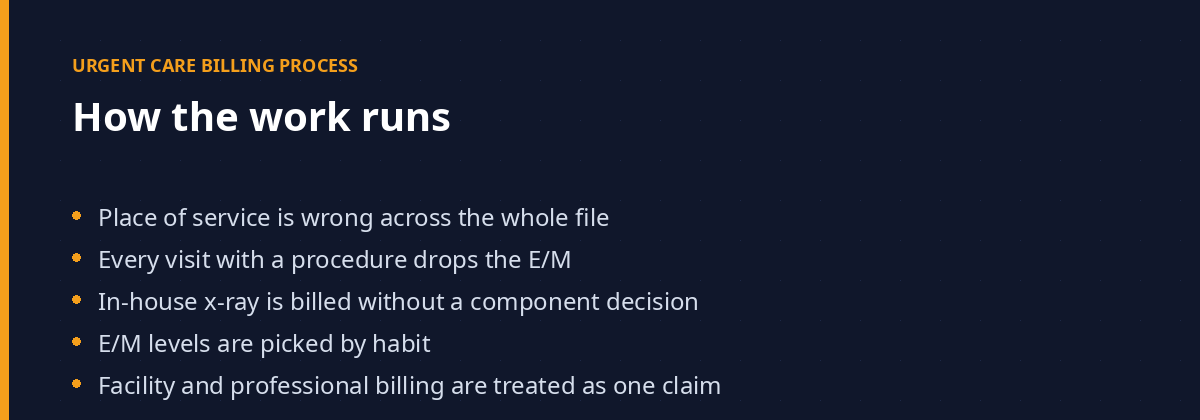
Place of service is wrong across the whole file
POS 20 marks an urgent care center, POS 11 a physician office, POS 22 a hospital outpatient department and POS 23 an emergency room. Most practice management systems were configured for an office, so the default stays at 11 and nobody sees it until a payer reprices the claim or a contract that pays urgent care at its own rate is applied to the wrong setting. Billing a freestanding clinic under POS 23 is the expensive version of the same mistake, because it claims an emergency rate the payer will reverse.
Every visit with a procedure drops the E/M
A laceration repair (12001-12007), a splint application (29125-29130), a therapeutic injection (96372), a point-of-care strep test (87880) or an ear irrigation (69210) sits inside the same visit as the evaluation, and payers bundle the E/M into the service unless modifier 25 is on the E/M line. Without it the practice gets paid for the cheaper service and the visit-level work disappears. Adding 25 to every same-day procedure is not the fix either, because the modifier holds only when the note documents evaluation and decision making beyond the procedure.
In-house x-ray is billed without a component decision
Chest films 71045 through 71048 carry a professional component for the interpretation and a technical component for the equipment and technologist. A clinic that owns the machine and has its own provider read the film bills global. A clinic whose provider interprets an image taken elsewhere bills 26 alone. When global goes out on a study the practice never produced, the payer either recoups it on audit or treats the pattern as billing for services that were not rendered.
E/M levels are picked by habit
Since the office visit guidelines changed, the level follows medical decision making or total time on the date of the encounter rather than the old history and examination bullets. Templates written for a different decade still push a default 99213, so higher-complexity visits at 99214 and 99215 are undercoded every day, and the notes on file would not defend the higher level even if someone corrected the charge later.
Facility and professional billing are treated as one claim
S9088 reports an urgent care facility service in addition to an E/M, while S9083 is a global facility fee that stands in for the visit. Some state Medicaid programs and commercial plans accept one or the other, Medicare assigns both an invalid payment indicator, and billing S9083 next to an E/M on the same encounter is a duplicate. Provider-based clinics add a second layer, because the facility charge belongs on a UB-04 with revenue codes while the professional charge stays on the CMS-1500.
Coverage rules differ by payer and by season
Commercial plans set their own urgent care benefit tier and copay, some require a referral for the specialist follow-up ordered at the visit, and advanced imaging ordered from the clinic often needs prior authorization before the patient is scheduled. Workers compensation and occupational health claims run on state fee schedules with their own forms and reporting rules, and Medicaid managed care varies from state to state. One claim build for all of it produces denials that look random and are not.
From Claim Audit to Clean Volume in Five Stages
Urgent care punishes a slow front end, so the work starts at the encounter and moves backwards to the denials it created.
Audit the code and place of service mix
We pull twelve months of claims and rebuild the picture: E/M level distribution by provider, place of service by location, modifier use on same-day procedures, procedure and x-ray capture per encounter, and denial rate by payer. The distribution tells you where the money is going, because a clinic billing nothing above a 99213 is either treating only minor complaints or leaving revenue on every chart.
Rebuild the claim rules in your system
Place of service is pinned to the location rather than to whoever registers the patient. Same-day procedures trigger a modifier 25 prompt on the E/M line. X-ray codes carry a component rule that matches who owns the equipment and who reads the study. S9088 and S9083 are switched on only for the payers that recognize them, and charge capture moves to the point of care so a splint applied at 8pm is on the encounter before the patient leaves.
Correct and refile the open claims
Claims with a wrong place of service or a missing modifier 25 go back as corrected claims rather than as duplicate submissions. Bundled-E/M denials are appealed with the encounter note attached and the level argued from medical decision making. X-ray claims billed with the wrong component are refiled with 26 or TC as the record supports, not as a blanket correction.
Work denials by remittance code
CO-16 for missing or invalid information, CO-97 for a service bundled into another, CO-4 and CO-29 for procedure and filing problems, medical necessity denials on higher-level visits, and coordination of benefits claims that went to the wrong plan. Each category has its own fix and its own appeal path, and the queue is measured by what closed this week rather than by how many claims were touched.
Report it and hold the front end
You get a monthly view of clean claim rate, E/M level mix, procedure and imaging capture, denial rate by payer and days in A/R, alongside the registration and coding changes that would stop the same denials appearing next month. The reporting is the visible half of the work. The other half is that the 0 to 30 bucket stays clean, so the volume you already have stops paying for avoidable rework.
The Work Inside Urgent Care RCM
Six workstreams that run against the same encounter volume at the same time.
E/M coding for 99202-99215
Levels assigned from medical decision making or documented time, with the note reviewed whenever the level moves up rather than after a payer asks for it.
Same-day procedure capture
69210, 96372, 12001-12007, 29125-29130 and point-of-care testing such as 87880 for strep billed with the E/M they accompanied, with modifier 25 applied only where the record supports a separate service and QW recorded on waived tests.
In-house imaging billing
71045 to 71048 coded by the number of views and billed global, 26 or TC according to who takes the image and who interprets it.
Place of service and facility billing
POS 20 and 22 set per location, S9088 and S9083 used only where a payer recognizes them, and UB-04 facility charges separated from professional claims.
Denial management and appeals
Every denial worked from its remittance code, with corrected claims refiled and appeals argued from the documentation already in the chart.
Reporting and patient balances
Monthly reporting on level mix, capture rates, denial causes and A/R, plus collection of patient responsibility at the desk while the balance is still fresh.
What Changes When the Encounter Is Captured Properly
The same clinics, the same payers and the same visit volume. What changes is the decisions recorded on each encounter before the claim leaves.
| What changes | Without a process | With MedFactor |
|---|---|---|
| Place of service | Left at the system default | Set per location and reviewed against the contract |
| Same-day procedures | E/M absorbed into the procedure | Modifier 25 applied where the note supports it |
| In-house x-ray | Billed global by default | Global, 26 or TC matched to equipment and interpretation |
| E/M level selection | 99213 on nearly every chart | Level argued from medical decision making |
| Denials | Refiled unchanged | Corrected claims and appeals with the note attached |
| Reporting | Visit count and cash collected | Level mix, capture rates and denial causes by payer |
Urgent Care Billing Questions Answered
The questions clinic owners and managers ask before moving their claim build off the front desk.
A visit is billed with the office or other outpatient series: 99202 to 99205 for a new patient and 99211 to 99215 for an established patient. The level comes from medical decision making or total time on the date of the encounter, and urgent care uses this series because the service is delivered in an outpatient setting. Emergency department codes 99281 to 99285 belong to a hospital emergency department and are not the right series for a freestanding urgent care center, even though some of the presenting complaints are the same.
It depends on the payer, and the two codes do different jobs. S9088 reports an urgent care center facility service in addition to an E/M, so it is an add-on to a visit that is already billed. S9083 is a global facility fee that stands in for the visit, which means billing it on the same encounter as an E/M invites a duplicate denial. Medicare assigns both codes an invalid payment indicator and pays neither. Some state Medicaid programs and a number of commercial plans recognize one but not the other, so the rule has to be built payer by payer rather than applied across the board.
The place of service tells the payer which fee schedule applies and what the patient owes. POS 20 is an urgent care center, distinct from both a physician office and a hospital emergency room, and it is priced on the office or urgent care fee schedule. POS 23 is a hospital emergency department, priced on the emergency fee schedule with a facility charge and a different copay. A freestanding clinic that bills POS 23 is claiming a setting it does not operate in, which payers reprice and, if the pattern continues, treat as a compliance matter rather than a coding error.
99051 covers services provided in the office during regularly scheduled evening, weekend or holiday hours, so it applies when the clinic is routinely open during those hours rather than when staff stay late on a Tuesday. It is billed in addition to the basic service, and it is separate from 99050, which covers services requested outside of regularly scheduled hours. Medicare does not pay it, so it is largely a Medicaid and commercial code, and coverage varies by plan.
No. A chest radiograph coded 71045 through 71048 has a professional component for the interpretation, billed with modifier 26, and a technical component for the equipment and the technologist, billed with modifier TC. When your provider interprets an image taken at an imaging center or a hospital, only 26 is billable. When the clinic owns the equipment and performs the study, you bill globally or split the components according to the contract and the site of service. Reporting global on a study you did not produce is a recoupment risk rather than a coding preference.
The note has to show that the evaluation was a separate service from the procedure: a problem addressed, decision making about the patient's condition, and a plan that goes beyond the repair or the injection itself. A chart that documents only the laceration and its closure cannot support an E/M line on the same date, and a chart that documents a full evaluation of an unrelated problem is what a payer expects to see. We review the encounters where 25 is applied most often, because that is the first place payers and auditors look.
69210 describes removal of impacted cerumen requiring instrumentation and carries a maximum unit of one per encounter, so billing it twice for two ears is denied as a duplicate. Irrigating wax that is not impacted does not support the code at all, which is the more common problem. Where the visit also included a separate evaluation, the E/M is billed with modifier 25 and the note has to support both services.
Most urgent care encounters need none, which is part of what makes the setting attractive to patients. The exposure sits in what the visit generates: advanced imaging such as CT or MRI ordered from the clinic frequently needs authorization before the patient is scheduled, and some commercial plans require a referral for specialist follow-up. Workers compensation and occupational medicine claims follow state fee schedules with their own reporting requirements, and some require preauthorisation of the treatment plan. We build those checks into the scheduling workflow so the authorization is not discovered missing on the claim.
Related specialties we bill for
The same code-level precision applies across the practice spectrum. See how we bill these related areas.
Sources and further reading
The rules these pages describe are published. Check them against the primary sources:
- CMS Physician Fee Schedule, which covers the published rates and payment rules behind most of the codes these pages discuss.
- CMS Physician Self-Referral (Stark Law), which covers the rules governing referrals between a practice and its own ancillary services.
- AAPC, which covers the coding and billing standards body whose credentialing most billers hold.
- HHS Office of Inspector General, which covers enforcement guidance on billing compliance and the areas it targets.


See where your visit mix is really losing money
Send us ninety days of claims along with your fee schedules. We will show you the place of service distribution, the E/M level mix against the complexity your notes document, how much procedure and imaging revenue is being bundled away, and which denials are worth refiling. No obligation, and the numbers are yours to keep.