Psychotherapy Is Billed by the Clock. The Note Has to Show the Minutes.
Psychotherapy has no procedure to point at. The claim is the time, the time is the note, and the difference between a 45 minute code and a 60 minute code is a line of documentation that most practices never write. Layered on top are the add-on codes that pay for the medical visit on the same day, family and group codes that depend on who was in the room, and a telehealth place of service rule that quietly underpays a large share of sessions. Every one of those is a decision made in the note before the claim exists.

Why Counseling Claims Get Downcoded or Denied
Time, who was in the room and which clinician is on the claim. Those three facts decide most mental health reimbursement.
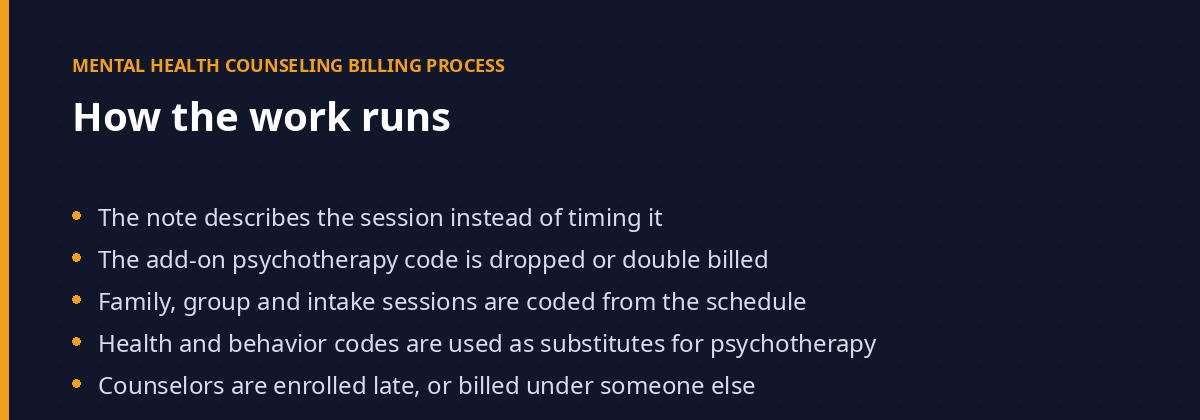
The note describes the session instead of timing it
90832, 90834 and 90837 are selected by documented minutes: 16 to 37, 38 to 52, and 53 and above. A note that reads well but never states the total minutes of psychotherapy leaves the coder choosing between an unsupported 90837 and a defensible 90834, and the safe answer is always the lower code. More than half of the session time also has to be psychotherapy rather than assessment, care coordination or documentation, which is the second fact a reviewer looks for.
The add-on psychotherapy code is dropped or double billed
90833, 90836 and 90838 pay for psychotherapy delivered during the same encounter as a significant E/M service, using the same three time bands. They are only billable with the E/M, they need the E/M and the psychotherapy documented as separate services, and the E/M carries modifier 25. The common failures run in both directions: the add-on left unbilled on hundreds of medication management visits, and the same psychotherapy minutes reported once as 90838 and again as 90834 for the same patient on the same day.
Family, group and intake sessions are coded from the schedule
90846 is family psychotherapy without the patient present and 90847 is conjoint family psychotherapy with the patient in the room, so the two are not interchangeable and the note has to state who attended. 90853 is group psychotherapy, billed once per patient per group session regardless of how long the group ran, and it cannot be paired with an individual psychotherapy code for the same patient on the same day. The intake has its own split between 90791 and 90792 depending on whether a medical evaluation was part of it.
Health and behavior codes are used as substitutes for psychotherapy
The 96156 series pays for assessment and intervention directed at the psychological factors complicating a physical condition, so the primary diagnosis has to be physical rather than a mental health condition. 96156 is event based and billed once per day regardless of time, while 96158 and 96159 for individual work, 96164 and 96165 for group, and the family sets are base codes with add-ons. They are not interchangeable with psychotherapy on the same day, and the codes for intervention without the patient present are excluded by Medicare and by many commercial plans.
Counselors are enrolled late, or billed under someone else
Licensed clinical social workers have billed Medicare in their own right for decades, and since 1 January 2024 marriage and family therapists and mental health counselors can enroll and bill Medicare directly at 75 percent of the clinical psychologist rate. Licensed professional counselors are a commercial and Medicaid category rather than a Medicare one. Psychotherapy is not billable as a service incident to a physician's work, so a supervising clinician's NPI cannot stand in for an unenrolled counselor, and claims that try come back with a rendering provider eligibility denial.
Telehealth sits on one place of service code and one modifier
Modifier 95 certifies a synchronous audio and video session and modifier 93 an audio only session, and neither changes the rate. The place of service does. A patient at home is reported in the home telehealth code, which pays the non facility rate, while the code for telehealth elsewhere pays the facility rate. A practice that leaves one code as the system default across every session is systematically underpaid on most of its claims. Plan level visit caps compound it: a plan that allows a set number of psychotherapy visits in a year denies the next one no matter how well it was documented.
Five Stages From Note Audit to Correct Claims
Time first, then the room, then the clinician, then the claim. Fixing them in the other order leaves the same denials coming back.
Audit notes against the clock
We sample sessions across every clinician and rebuild the code the documentation supports: total minutes of psychotherapy, the proportion of the session spent in psychotherapy, whether the E/M and the add-on are documented as separate services, and whether family or group sessions name who attended. The difference between the codes billed and the codes supported is the first number you see, and it is usually concentrated in one or two clinicians.
Fix time capture where the note is written
The change that holds is in the template and the habit rather than in the billing queue. Total minutes of psychotherapy becomes a required field, the E/M and the psychotherapy get their own documented time, and the add-on codes are proposed whenever a qualifying E/M and separate psychotherapy appear in the same encounter. Coders then select from documented minutes rather than from the appointment length.
Enroll every clinician who renders
We check enrollment for each counselor with Medicare, state Medicaid and each commercial payer, match the enrollment to the taxonomy the payer expects, and compare effective dates against the first dates of service. Claims already billed under another clinician's NPI are corrected and resubmitted under the person who delivered the service, and any practitioner who is not enrolled is kept out of the claim flow until enrollment lands.
Correct telehealth and work the denial queue
Telehealth defaults are rebuilt per payer: modifier 95 or 93 as the modality requires, the home code for patients at home and the other code where they are not, applied consistently from the appointment type rather than from memory. Downcoded 90837 claims are reviewed for documented time and appealed where the note supports the code, CCI bundling edits are challenged only where the services were genuinely separate, and plan visit caps are tracked so a denial at the limit is a billing decision rather than a surprise.
Report and hold the standard
You receive monthly reporting by clinician, by payer and by code, with the share of sessions billed at each time band and the denial reasons behind the rest. Downcoding trends are visible in that report before they reach a payer audit, add-on capture is measured rather than assumed, and new clinicians are added to the enrollment and template standards before their first claim.
The Work Inside Counseling Revenue Cycle Management
Six workstreams that keep the claim aligned with what the note can support.
Time based psychotherapy coding
90832, 90834 and 90837 selected from documented minutes, with the 16, 38 and 53 minute thresholds applied the same way on every claim.
E/M add-on capture
90833, 90836 and 90838 billed with the qualifying E/M, separate documentation on both services and modifier 25 where the payer requires it.
Family, group and intake billing
90846, 90847 and 90853 coded to who was in the room, with 90791 and 90792 sequenced correctly against the psychotherapy codes.
Assessment and screening codes
96127 brief emotional and behavioral assessment, the 96156 health and behavior series against its physical diagnosis rule, and the documentation each one requires.
Provider enrollment and credentialing
LCSW, LMFT, MHC and LPC enrollment with Medicare, state Medicaid and commercial payers, with effective dates checked against dates of service.
Telehealth compliance and reporting
Place of service and modifier rules set per payer, visit caps tracked, and monthly reporting on time band distribution and add-on capture.
What Changes When Time Is Documented
The same clinicians, the same payers and the same sessions. What changes is what the note proves and who checks it.
| What changes | Without a process | With MedFactor |
|---|---|---|
| Session time | A note describing what was discussed | Total minutes stated and matched to the band |
| E/M with psychotherapy | Add-on dropped, or both codes billed for one service | Separate time documented and modifier 25 applied |
| Family and group | Chosen from the appointment type | Matched to who attended the session |
| Rendering provider | Whichever clinician is on the account | The enrolled counselor who delivered the service |
| Telehealth place of service | One default code on every session | Home and elsewhere coded as they were |
| Visit caps | Found when the next visit denies | Tracked against each plan's limit |
Mental Health Billing Questions Answered
What counseling practice owners ask before changing how sessions are coded and billed.
90832 covers 16 to 37 minutes of psychotherapy, 90834 covers 38 to 52 minutes and 90837 covers 53 minutes and above. The total minutes of psychotherapy belong in the note, and more than half of the session has to be psychotherapy rather than assessment, coordination or documentation. Sessions shorter than 16 minutes are not billable as psychotherapy. Selecting the code from documented minutes rather than appointment length is what keeps a 50 minute session at 90834 instead of an unsupported 90837.
Those are add-on codes for psychotherapy delivered in the same encounter as a significant E/M service, using the same 16, 38 and 53 minute thresholds. They require the E/M to be a separately documented service, and the E/M carries modifier 25. The add-ons are billed in addition to the E/M, never in addition to 90832, 90834 or 90837 for the same encounter, and the psychotherapy time cannot be counted in both the E/M and the add-on. Documenting the two services separately is what makes the claim defensible.
90791 and 90792 are standalone diagnostic evaluations and are not reported with the psychotherapy codes on the same date of service. 90791 covers a psychiatric diagnostic evaluation without medical services and 90792 includes a medical evaluation within the same encounter, so the choice between them is a statement about what happened. Where a payer's policy allows an intake and treatment on one day, that permission comes from the payer's own published rule rather than from the code set.
90846 is family psychotherapy without the patient present and 90847 is family psychotherapy with the patient present. Both are time based, and the note has to name who attended, because the two codes are not substitutes for each other. 90853 is group psychotherapy, reported once for each patient in the group regardless of the length of the session, and it is not billed alongside an individual psychotherapy code for the same patient on the same day. Group size rules come from the payer, and several plans require at least three participants.
96156 is a health behavior assessment or reassessment, billed once per day regardless of how long it took, and the 96158 series covers intervention for an individual, a group or a family, with base codes for the first 30 minutes and add-on codes for additional time. The primary diagnosis has to be physical, because the service addresses the psychological and behavioral factors complicating a medical condition. They are not substitutes for psychotherapy, and the codes for intervention without the patient present are excluded by Medicare and by many commercial plans.
Marriage and family therapists and mental health counselors have been able to enroll with Medicare and bill directly since 1 January 2024, paid at 75 percent of the clinical psychologist rate. Licensed clinical social workers have had their own Medicare benefit for far longer. Licensed professional counselors are recognized by many commercial plans and state Medicaid programs but are not a Medicare practitioner category, so their claims belong on the plans that enroll them. Enrollment runs through PECOS or a paper application, and each clinician needs the enrollment completed before their first date of service.
The modality drives the modifier and the patient's location drives the place of service. Modifier 95 certifies a synchronous audio and video session, modifier 93 an audio only session, and neither changes what the payer pays. A patient at home is reported in the home telehealth place of service, which pays the non facility rate, while telehealth delivered from anywhere else pays the facility rate. Because the default in most practice management systems is the older code, a practice that never revisits it is underpaid on the majority of its virtual sessions. Payer parity rules and state licensure requirements still apply on top.
Many do, and the limits are plan specific rather than payer wide. Some commercial plans cap psychotherapy visits in a calendar year, some require authorization after a set number of sessions, and some review the share of sessions billed at the longest time code. A well documented session cannot override a plan limit, so the practical answer is to know each plan's cap, track visits against it, and use the authorization and continued stay review process where the plan provides one.
Related specialties we bill for
The same code-level precision applies across the practice spectrum. See how we bill these related areas.
Sources and further reading
The rules these pages describe are published. Check them against the primary sources:
- CMS Physician Fee Schedule, which covers the published rates and payment rules behind most of the codes these pages discuss.
- CMS Physician Self-Referral (Stark Law), which covers the rules governing referrals between a practice and its own ancillary services.
- AAPC, which covers the coding and billing standards body whose credentialing most billers hold.
- HHS Office of Inspector General, which covers enforcement guidance on billing compliance and the areas it targets.


See what your notes can actually support
Send us a month of psychotherapy claims and a sample of notes from each clinician. We will show you where the documented time sits against the codes billed, what the add-on capture rate is, and which telehealth place of service is costing you money.