ABA Is Billed in Fifteen Minute Units. The Authorization Sets the Ceiling.
Every ABA code is a measure of time and a statement about who was in the room. A technician's fifteen minutes is not a behavior analyst's fifteen minutes, the authorization that pays for the work is issued in units per week with an expiry date attached, and the payer wants a record that shows the plan working. Practices lose money in the gaps between those three facts: units counted at month end from the schedule, a supervising clinician's NPI attached to work a technician performed, and a renewal request sent the week the authorization lapsed.

Why ABA Claims Come Back Denied or Clawed Back
ABA denials are rarely coding mistakes. They are time, authority and provider attribution problems that repeat every week until the front end changes.
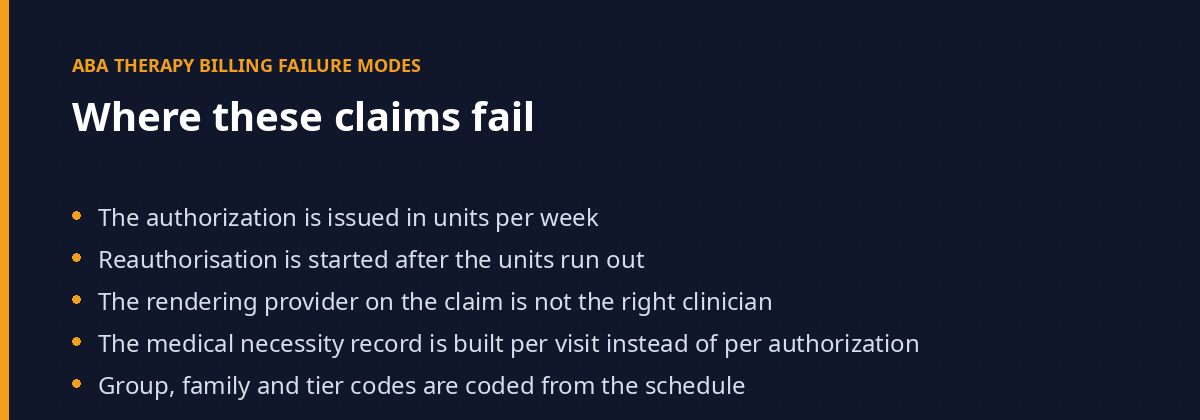
The authorization is issued in units per week
An authorization for 20 units of 97153 a week is not a budget for the month. Delivering 26 units in one week and 14 the next is 6 unauthorised units, and payers recover those on post payment review long after the sessions were worked. Daily caps sit on top of the weekly figure, so a practice can stay inside its weekly total and still breach a per day limit that nobody loaded into the scheduling system.
Reauthorisation is started after the units run out
Most payers take weeks to review a renewal, and many refuse a retrospective request outright. Every session delivered between the expiry date and the new authorization is unbillable, which turns a two week administrative delay into real money. Commercial plans and Medicaid programs also require a fresh behavior identification assessment before they will renew, so the renewal clock starts earlier than the expiry date suggests.
The rendering provider on the claim is not the right clinician
97153 and 97154 are billed under the technician who delivered the treatment, while 97151, 97155, 97156, 97157 and 97158 require a qualified health care professional. Billing 97155 under a technician's NPI, or a supervisor's NPI for technician work, is a recoupment target rather than a small error. Technicians also have to be enrolled and credentialed with each payer, and a claim from an unenrolled rendering provider is denied before anyone reads the note.
The medical necessity record is built per visit instead of per authorization
Payers do not ask whether the session happened. They ask whether the treatment is medically necessary at the intensity requested, and they answer that question from an assessment with a standardized instrument such as the Vineland-3, ABLLS-R or VB-MAPP, a treatment plan with baseline data and measurable goals, and progress reports that show movement against those goals. Records assembled in a hurry at review time read as activity, not as a plan.
Group, family and tier codes are coded from the schedule
97153 is one patient, 97154 is group treatment by a technician, 97158 is group treatment with protocol modification by a qualified professional, and 97157 is multiple family group guidance rather than the single family work billed as 97156. The tier codes are narrower still: 0362T and 0373T describe a qualified professional on site directing two or more technicians for a patient who exhibits destructive behavior in an environment customised to that behavior, reported per fifteen minutes of technicians' time in place of the standard codes.
Place of service and telehealth rules are set once and never revisited
ABA is delivered where the patient is, so the place of service code has to follow: home, clinic, school and community settings each carry their own code, and the supervising clinician's location does not drive it. Telehealth sessions carry their own combination of place of service and modifier, and a default set for one payer quietly understates or misstates every claim after it. State autism mandates and Medicaid program rules differ on what remote delivery they will pay for at all.
Five Stages From Unit Audit to Clean Authorizations
The sequence that matters is authority first, then documentation, then claims. Worked in the other order, the same effort produces denials.
Audit units against the clock
We sample sessions across every technician and clinician and rebuild the unit count from the documentation rather than from the schedule: start and stop times in the note, fifteen minute increments, and the midpoint convention the payer applies. The output is the difference between what was worked, what was authorized and what was billed, which is the size of the exposure before anything else is touched.
Rebuild the authorization ledger
Every open authorization is loaded with its authorized units per week, any daily maximum, the start and end dates, the servicing provider types it permits and the payer's reassessment requirement. That ledger becomes the scheduling constraint and the renewal calendar. Renewal work begins sixty days before expiry, because a review that takes three weeks and a reassessment that takes two cannot be started inside the final fortnight.
Rebuild the medical necessity packet
We assemble the record the way an ABA reviewer reads it: diagnostic confirmation from the diagnosing clinician, the standardized assessment with scores and dates, the treatment plan with baseline and measurable goals, the data sheets that show progress, and the caregiver participation the plan promised. The packet is kept current as a living file so a renewal is an update rather than a rebuild.
Clean the claims in flight
Unauthorised unit denials are appealed with the authorization and the attendance record attached. Claims billed under the wrong rendering provider are corrected and resubmitted under the clinician who delivered the service. Medical necessity denials get a clinical appeal built on the packet rather than a restatement of the billing argument, and recoupment letters get a documented response inside the payer's own window.
Hold the front end and report it
Units are released to the schedule only inside the current authorization, technicians and clinicians are enrolled before their first claim, and the renewal calendar drives the work backwards from expiry. You receive monthly reporting by payer, by denial reason and by unit variance, so the same overage does not reappear under a different technician's name next quarter.
The Work Inside ABA Revenue Cycle Management
Six workstreams that run against the same authorization ledger and the same clinical record.
ABA coding and unit capture
97151 through 97158 and the tier codes 0362T and 0373T coded to the time, the provider and the facts each descriptor requires.
Authorization and renewal management
Units per week, daily caps, servicing provider types and expiry dates loaded into a ledger, with renewals started before the current authorization lapses.
Provider enrollment and credentialing
Technicians and behavior analysts enrolled with each payer and Medicaid program, with effective dates checked before the first claim goes out.
Medical necessity documentation
Assessment batteries, treatment plans with baseline and measurable goals, progress data and caregiver records assembled to the payer's own review list.
Denial management and appeals
Unit overage, medical necessity, rendering provider and authorization denials appealed at the level the amount justifies, with recoupment letters answered on time.
Payer contracts and reporting
Rate, cap and timely filing terms extracted from each contract, with monthly reporting on unit variance, denial cause and authorization performance.
What Changes When Units Are Counted From the Note
The same technicians, the same patients and the same payers. What changes is where the unit count comes from and who checks it.
| What changes | Without a process | With MedFactor |
|---|---|---|
| Unit counting | Hours from the schedule, reconciled at month end | Fifteen minute units traced to the times in each note |
| Authorizations | Renewed after the units run out | Renewal started sixty days before expiry |
| Provider on the claim | Whichever NPI sits on the account | The technician or clinician who delivered the service |
| Medical necessity record | Chart pulled when a review arrives | A live packet built to the payer's review list |
| Group and tier codes | Coded from the schedule and the room | Matched to the facts the descriptor names |
| Place of service | One code for every claim | Home, clinic, school and remote delivery coded as they were |
ABA Billing Questions Answered
What ABA owners and clinical directors ask before handing over authorizations and claims.
One unit is fifteen minutes of face to face time, and codes 97151 through 97158 are all reported in those increments. The note has to show the time worked rather than the time scheduled, and most payers count a unit once at least eight of the fifteen minutes were delivered. Units are counted from documented face to face contact, so travel, note writing, data analysis in a session and team meetings do not create units. Where a clinician's time is spent doing technician work, that time is reported as technician time.
97152, 97153, 97154, 0362T and 0373T describe technician time and are billed under the technician who delivered the service under the direction of a qualified health care professional. 97151, 97155, 97156, 97157 and 97158 describe the qualified professional's own time and are billed under that clinician. The distinction is not cosmetic: a recoupment review is triggered by a technician code billed under a supervisor's NPI and by protocol modification billed under a technician, because the descriptors name who performs each service.
Sessions delivered beyond the authorized units are generally not payable, and payers recover them on post payment review. There is no appeal that turns an unauthorised unit into a paid one; the argument available is that the authorization was for a different number than the payer's file shows, and that argument needs the approval notice, the reference number and the unit figure kept together. The workable fix is upstream: the authorized units loaded as a scheduling limit and a renewal started weeks before expiry.
A diagnosis confirmed by a qualified diagnosing clinician, a standardized assessment with scores and dates such as the Vineland-3, ABLLS-R or VB-MAPP, a treatment plan stating baseline data and measurable goals, progress data showing movement against those goals, and evidence that caregivers take part in the plan. Reviewers are asking whether the intensity requested is clinically justified. A packet that shows the treatment plan being followed and adjusted answers that question; a packet of session notes alone usually does not.
Yes, when they describe different time. 97155 includes the qualified professional directing a technician while modifying the protocol, so the same minutes cannot be counted twice under both codes. A session where the analyst modifies the plan and directs the technician is 97155, and the technician's separate direct treatment time is 97153. Payers examine the overlap closely, and a duplicate minute is the finding that starts a broader unit review on the whole authorization.
Those tiered codes describe a narrower situation than the standard codes: the physician or other qualified health care professional is on site, two or more technicians are assisting, the patient exhibits destructive behavior such as self injury, and the session happens in an environment customised to that behavior. They are reported per fifteen minutes of technicians' time and take the place of the standard treatment codes for that time rather than adding to them. Using them without those facts documented invites a takeback on the entire authorization.
The place of service code follows the patient's location: home, clinic and school settings each carry their own code, and the location of the supervising clinician does not change it. Remote sessions carry the telehealth place of service and modifier the payer asks for, applied consistently rather than left as a system default. Because ABA is governed by state autism insurance mandates, state Medicaid program rules and TRICARE's autism care program rather than one national benefit, we check the payer and the state before assuming a delivery model is billable.
Medicare fee for service does not carry a national ABA benefit for autism spectrum disorder, so most ABA revenue sits with commercial plans under state autism insurance mandates, state Medicaid programs and TRICARE's autism care program. Medicare Advantage plans may cover ABA as a supplemental benefit, which means the requirements in an individual plan document can be stricter than the commercial rules the practice already knows. We build the payer matrix before the first claim so the billing rules follow the plan rather than the payer name.
Related specialties we bill for
The same code-level precision applies across the practice spectrum. See how we bill these related areas.
Sources and further reading
The rules these pages describe are published. Check them against the primary sources:
- CMS Physician Fee Schedule, which covers the published rates and payment rules behind most of the codes these pages discuss.
- CMS Physician Self-Referral (Stark Law), which covers the rules governing referrals between a practice and its own ancillary services.
- AAPC, which covers the coding and billing standards body whose credentialing most billers hold.
- HHS Office of Inspector General, which covers enforcement guidance on billing compliance and the areas it targets.

Find out what your authorizations really cover
Send us your current authorization letters and a month of 97153 and 97155 claims. We will rebuild the unit count from your documentation, list what sits outside the authorized units, and show you the two changes that stop the next overage.