In IR the Money Is in the Op Note. Vessels, Components and Bundled Guidance Decide the Claim.
An interventional radiology claim rests on three things the record has to settle: which vessels the catheter reached, whether a guidance code stands on its own or is already inside the procedure, and who owns the equipment that produced the images. Settle them correctly and the claim matches the work performed. Settle them badly and a four-figure case pays like a consult, or a bundled guidance code turns an otherwise clean claim into a compliance question. We code, scrub, submit and appeal on that basis.
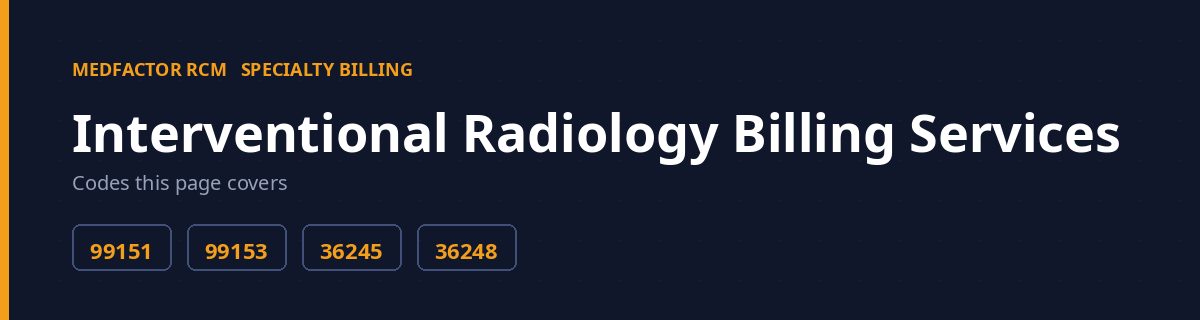
Why IR Claims Get Denied and Undercoded
Interventional cases are high value and heavily bundled, which means the errors cluster in the same places on every claim. None of them are billing mysteries once the note is read properly.
Guidance codes are billed on procedures that already include them
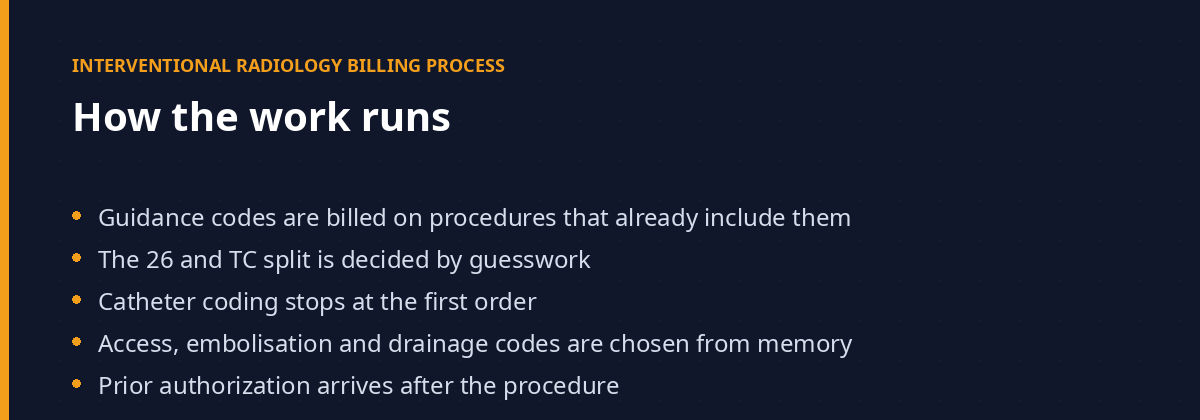
76942 for ultrasound guidance, 77012 for CT guidance, 77021 for MR guidance and 77002 or 77003 for fluoroscopic guidance all describe supervision and interpretation of needle placement. Many interventional codes already include that supervision and interpretation, and the national correct coding edits bundle the guidance into the primary procedure. Appending a guidance code anyway produces a denial on that line, slows the whole claim, and gives an auditor a pattern to examine.
The 26 and TC split is decided by guesswork
A study your practice performs and your physician interprets is billed globally. A study another facility performs and your physician interprets is billed with modifier 26 alone. The technical component covers the equipment, the technologist, the room and the supplies, and it belongs to whoever owns them. Groups that read for a hospital and bill global are handing the payer a recoupment case, while groups that bill only 26 on their own equipment leave the technical half permanently unpaid.
Catheter coding stops at the first order
36245 through 36248 price the catheterisation by the order of the vessel selected: first order 36245, second 36246, third 36247, and each additional order beyond the third 36248. Within a vascular family only the most distal vessel selected is reported, and a separate family selected from its own arterial origin is reported separately. Defaulting to 36245 on a case where the catheter reached a third-order hepatic or renal branch gives away the most valuable part of the procedure.
Access, embolisation and drainage codes are chosen from memory
Central venous access runs from 36555 to 36569 with separate codes for non-tunneled and tunneled devices, ports and pumps, and age bands under five years and five years and older. Embolisation splits four ways by purpose, with 37241 for venous work, 37242 for arterial work outside hemorrhage, 37243 for tumors, organ ischemia and infarction, and 37244 for hemorrhage or lymphatic leaks.
Gastrostomy work runs 49440 to 49442, with 49446 covering conversion of a gastrostomy tube to a gastrojejunostomy tube, a percutaneous lung or mediastinal biopsy is 32405, and pleural work spreads across 32550 to 32557, with 32551 for tube thoracostomy, 32552 for removal of a tunneled pleural catheter, 32554 and 32555 for thoracentesis without and with imaging guidance, and 32556 and 32557 for imaging-guided pleural drainage. The wrong code from the right family is still a wrong code, and it is usually found on audit rather than at submission.
Prior authorization arrives after the procedure
Advanced imaging ordered before an intervention frequently needs authorization, radiology benefit managers handle that work for a large share of commercial plans, and the CMS prior authorization model applies to certain imaging services delivered in hospital outpatient departments. Payer medical policies then add criteria of their own for uterine fibroid embolisation, vertebral augmentation and peripheral intervention. When the authorization is missing on a 37243 case, the dispute is worth thousands and the appeal has nothing to do with coding quality.
The note does not support the level billed
Op notes that omit the vessels selected and the catheter positions, the contrast volume, the drugs and times used for sedation, the devices and their sizes, or the name of the supervising physician leave the coder guessing and the auditor with questions. Moderate sedation billed under 99151 to 99153 requires the physician's presence and documented time, and a claim without that record is denied or converted into an audit finding. Undercoding is the quieter loss, because cases that qualify for an additional family, a higher order catheter or a separately reportable drainage are billed as one simple line.
From Op Note to Paid Claim in Five Stages
Interventional billing is a documentation discipline before it is a billing process, so the audit starts with the notes rather than with the aging report.
Read the notes against the claims
A sample of procedures is rebuilt from the op note: vessels selected, catheter order, guidance used, components billed, sedation and devices. The gaps are counted rather than described, so you can see how many cases were undercoded by family or by order, and how many guidance lines went out where the edit bundles them.
Rebuild charge capture and code logic
Charge sheets are rebuilt by procedure family with prompts for second and third order vessels, additional families, and the guidance codes that are genuinely separate. Component rules are set by who owns the equipment and who reads the study. Sedation is captured with drugs, times and the presence of the supervising physician so the code is supported before the claim is built.
Correct and refile
Claims undercoded on catheter order, or missing a separately reportable service, go out as corrected claims with the op note attached. Bundling denials on guidance lines are appealed with the procedure descriptor and the coding rationale rather than resubmitted unchanged. Component errors are refiled as 26 or TC where the record supports it, and discontinued procedures are refiled with modifier 53 and the reason documented.
Put authorization in front of the schedule
Requests move to the point of scheduling, with payer criteria matched to the planned procedure and the clinical packet assembled to the policy the reviewer actually applies. Approvals are logged with their units and expiry dates, because a series of embolisations or a staged intervention can exhaust an authorization before the final case is performed.
Report by code family and audit quarterly
Monthly reporting on payment per procedure family, denial reasons, component and bundling outcomes, and days in A/R, with a quarterly documentation audit on the highest value codes. The audit sample is drawn from the procedures where a wrong code is expensive rather than from the highest volume, because that is where the money and the exposure sit.
The Work Inside Interventional Radiology RCM
Six workstreams that follow the procedure from scheduling through appeal.
Interventional coding and charge capture
Catheterisation coded by vascular family and order across 36245 to 36248, with central venous access 36555 to 36569, embolisation 37241 to 37244, gastrostomy 49440 to 49442, lung biopsy 32405 and pleural work 32550 to 32557 coded to the procedure actually performed.
Guidance and bundling review
76942, 77012, 77021 and 77002 or 77003 checked against the primary procedure so only guidance that is genuinely separate is billed on its own line.
Component management
Modifier 26 for interpretation alone, TC where the practice owns the equipment, and global only when the record supports both halves of the study.
Moderate sedation billing
99151 and 99152 for the first 15 minutes with the physician present, 99153 for each additional 15, supported by drugs, times and the observer in the record.
Prior authorization for IR
Policy criteria checked before the case is scheduled, clinical packets built to the payer's evidence list, and approvals tracked with their units and expiry dates.
Denials, appeals and compliance audit
Bundling and component denials appealed from the procedure descriptor, with a quarterly audit of the highest value codes read back against the op notes.
What Changes When the Case Is Coded From the Note
Same procedures, same payers and the same physicians. What changes is which details the record captures before the claim is built.
| What changes | Without a process | With MedFactor |
|---|---|---|
| Guidance codes | Billed on every procedure | Billed only where the edit allows it |
| Component split | Global by default | 26, TC or global matched to equipment and interpretation |
| Catheter selection | First order catheter on every case | Most distal vessel per family, additional families reported |
| Sedation | Treated as included in the procedure | 99151-99153 billed with documented time and presence |
| Prior authorization | Checked after the procedure | Verified before the case is scheduled |
| Documentation | Op note written for the chart | Vessels, devices and times recorded for the claim as well |
Interventional Radiology Billing Questions Answered
The questions practice managers and IR physicians ask before moving charge capture off a paper sheet.
Those codes report supervision and interpretation of needle placement under ultrasound, CT and MR guidance. They can stand on their own line only when the primary procedure does not already include that supervision and interpretation, and the national correct coding edits settle most of those questions. Where the procedure includes the guidance, billing it again produces a denial on that line and slows the rest of the claim. We check every guidance code against the procedure family before the claim is built rather than after the denial arrives.
The technical component covers the equipment, the technologist, the room and the supplies, while the professional component covers the interpretation. A practice that owns the equipment and interprets the study bills global, which is equivalent to billing 26 and TC together. A practice whose physician interprets a study produced elsewhere bills 26 alone. Diagnostic imaging read for a hospital is the classic place this goes wrong, because the hospital owns the equipment and should be billing the technical half under its own arrangement.
The catheterisation codes run 36245 for the first order, 36246 for the second, 36247 for the third and 36248 for each additional order beyond the third. Within a single vascular family only the most distal vessel selected is reported, so a case that reached the third order is coded 36247 rather than 36245. When a second family is selected from its own arterial origin, that family is coded separately, and 36248 applies where catheterisation continues beyond the third order in the same family.
The four codes separate by purpose rather than by vessel. 37241 covers venous embolisation or occlusion outside hemorrhage, 37242 covers arterial work outside hemorrhage and tumors, 37243 covers tumors, organ ischemia and infarction, and 37244 covers hemorrhage and lymphatic leaks. Each includes the radiological supervision and interpretation, the roadmapping and the guidance needed to complete the intervention, so a guidance code billed a second time on the same claim is denied. Uterine fibroid embolisation falls under 37243 and a varicocele embolisation falls under 37241.
A physician performing both the procedure and the sedation bills 99151 for a patient under five years or 99152 for a patient five years and older for the first 15 minutes, then 99153 for each additional 15 minutes. The record needs the drugs and doses, the times sedation started and ended, the patient's response, the monitoring performed, and confirmation that a qualified practitioner stayed present throughout. Sedation that is already included in the procedure code is not billed again, and the documentation is what separates the two situations.
The codes separate by device type and by patient age. Non-tunneled central venous catheters are 36555 under five years and 36556 for five and older. Tunneled devices without a port are 36557 and 36558, tunneled devices with a subcutaneous port are 36560 and 36561, and tunneled devices with a pump are 36563. Peripherally inserted central catheters have their own pair in 36568 and 36569. Removal and repair carry separate codes, and imaging performed only to confirm placement is bundled into the insertion rather than billed on its own line.
It depends on the payer and the setting rather than on the specialty. The CMS prior authorization model applies to certain imaging services delivered in hospital outpatient departments, most commercial plans route advanced imaging through a radiology benefit manager with its own portal and criteria, and payer medical policies add conditions of their own for procedures such as uterine fibroid embolisation, vertebral augmentation and peripheral intervention. The check belongs at scheduling, because a retrospective request on an elective case is usually refused outright.
The record has to name the vessels catheterised and the order in which they were selected, the guidance used, the devices and their sizes, the contrast volume, the sedation drugs and times, and the physician who supervised the case. It also has to state what was found and what was done, because a note that describes only the access leaves the coder with no basis for the therapeutic code. Documentation written for the chart and documentation written for the claim are the same document, and the difference in payment between a thorough note and a thin one is often four figures.
Related specialties we bill for
The same code-level precision applies across the practice spectrum. See how we bill these related areas.
Sources and further reading
The rules these pages describe are published. Check them against the primary sources:
- CMS Physician Fee Schedule, which covers the published rates and payment rules behind most of the codes these pages discuss.
- CMS Physician Self-Referral (Stark Law), which covers the rules governing referrals between a practice and its own ancillary services.
- AAPC, which covers the coding and billing standards body whose credentialing most billers hold.
- HHS Office of Inspector General, which covers enforcement guidance on billing compliance and the areas it targets.


See what your procedure mix is actually worth
Send us ninety days of op notes and the claims they produced. We will show you where catheter selection undercodes the work, which guidance lines are being bundled away, how your component splits line up with who owns the equipment, and what the corrections are worth per case.