Speech Therapy Claims Fail on Unit Rules
Speech-language pathology has the smallest code set in outpatient therapy and the widest variation in how payers pay it. Medicare treats 92507 as an untimed service billed at one unit, while many commercial payers pay the same code in 15 minute units, so the identical note produces a correct claim and an incorrect claim depending on who is reading it. Layer on a threshold shared with physical therapy, a discipline with no re-evaluation code, and swallowing diagnostics that carry their own interpretation codes, and the revenue cycle starts leaking in places a monthly charge report never shows.

Why Speech Therapy Claims Get Cut
SLP denials come from unit rules that change with the payer, code families that describe different work, and a threshold the discipline shares with another practice down the hall.
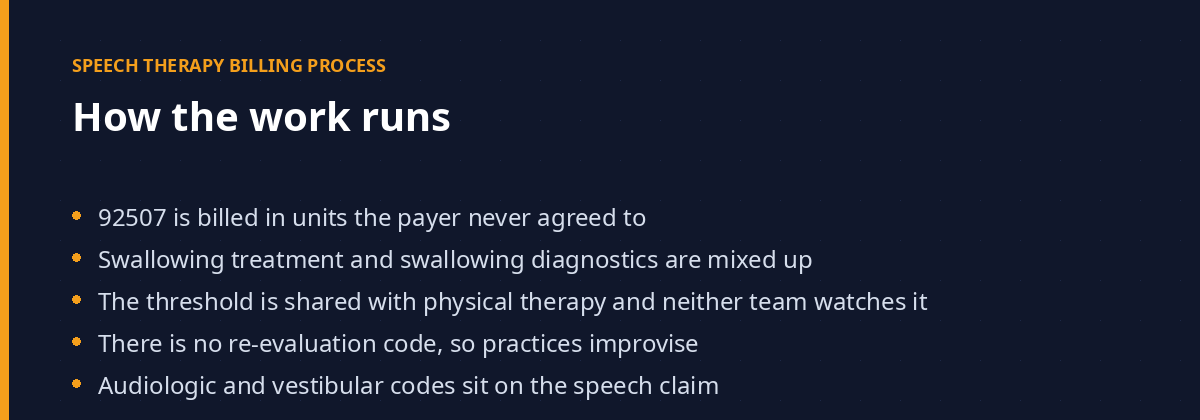
92507 is billed in units the payer never agreed to
Under Medicare, 92507 treatment of speech, language, voice, communication and auditory processing disorder is an untimed code reported at one unit for the date of service. Many commercial payers pay it in 15 minute units and expect several units for a 45 minute session. Billing three units on a Medicare claim produces a denial or a recoupment, and billing one unit on a commercial claim quietly underpaid the practice. The fix is a unit rule held per payer and per plan rather than one rule applied to every explanation of benefits.
Swallowing treatment and swallowing diagnostics are mixed up
92526 is treatment of swallowing dysfunction and oral function for feeding. 92610 is the clinical evaluation of oral and pharyngeal swallowing function performed at the bedside. 92611 is the videofluoroscopic study, and the 92612 to 92616 family covers flexible endoscopic evaluation, where the interpretation and report codes are separate and frequently dropped off the claim. Billing a diagnostic study as treatment hides the professional work, and billing treatment as a diagnostic study invites medical review of a service nobody ordered. Each carries its own documentation requirement and its own payer policy.
The threshold is shared with physical therapy and neither team watches it
Speech-language pathology and physical therapy draw on one $2,480 KX threshold for CY 2026. A long SLP episode can consume the PT headroom and the reverse, so a practice that tracks spend per department reports a clean position in both departments while the beneficiary is past the threshold in the combined account. Claims above it without the KX modifier are denied outright, and past $3,000 in the category they become eligible for targeted medical review.
There is no re-evaluation code, so practices improvise
Physical therapy has 97164 and occupational therapy has 97168 for re-evaluation of an established plan of care. Speech-language pathology does not have an equivalent, and the improvisation shows up three ways: a re-evaluation documented and billed as 92507 treatment, a full evaluation code repeated every few weeks, and a re-evaluation that never gets documented at all. Evaluation selection matters here too. 92521 covers fluency, 92522 covers speech sound production, 92523 adds language comprehension and expression, and 92524 covers voice and resonance.
Audiologic and vestibular codes sit on the speech claim
92587 and 92588 are otoacoustic emissions codes from the audiology section, with professional and technical components and their own frequency requirements: 3 to 6 frequencies for the limited study and at least 12 per ear for the comprehensive one. 95992 is canalith repositioning for benign paroxysmal positional vertigo, billed per day rather than per maneuver, so four Epley maneuvers in one visit are one unit. These belong to specific providers and settings, and a discipline mismatch or a modifier error on them reads to a reviewer like a coding pattern rather than a clerical slip.
Documentation proves attendance, not medical necessity
Speech therapy needs a certified plan of care like the other disciplines, with certification within 30 days of the first treatment day and recertification at least every 90 days. The documentation also has to show why skilled intervention is required for this patient: the specific deficit, the cueing and modeling provided, measurable change or maintenance of function, and the clinical reasoning behind the approach. Notes that record activities completed without the deficit or the response support a time entry and nothing more, which is how a claim with accurate units still gets denied.
Pediatric and school based charts add a second trap, because an educational need is not the same standard as medical necessity, and payer visit limits of 20 or 30 visits a year can close an episode before the clinical goals are met.
Five Stages From Chart Audit to Clean Claims
Each date of service gets three checks: does the code describe the work, does the unit count match the payer's rule, and does the documentation prove the service was skilled.
Audit codes and units against the notes
We take 30 to 60 days of treatment notes with the matching charge detail and rebuild every visit: which code family the work belongs to, whether the payer treats that code as timed or untimed, the units actually supported, and any interpretation or report code that was earned and never billed. Dropped FEES interpretation lines and downcoded swallowing work are listed with their dollar value.
Repair certification and clinical documentation
Every active plan of care is checked for the certifying signature and date, the 30 day certification window, the verbal order rule and the 90 day recertification cycle. Then the treatment note gets a standard: the deficit, the intervention and cueing, the patient's response, and the measurable progress or maintenance that shows why skilled speech therapy is required. Re-evaluations are documented as such even though there is no code that pays for them separately.
Build payer specific billing rules
For each payer your practice bills, we record whether 92507, 92508 and 92526 pay per session or per 15 minute unit, what the visit limit is, which codes need prior authorization, and how the payer handles the 92612 to 92616 family. Those rules go into the charge capture and scrub step, with GN on every therapy line and the correct discipline modifiers kept off lines that do not belong to the speech benefit.
Work the denials by remittance reason
Denials are triaged by remittance code rather than by age. Unit denials go back with the payer's own payment policy attached. Medical necessity denials get a clinical appeal built from the plan of care, the objective measures and the progress reports. Timely filing disputes go out with the clearinghouse acknowledgement as proof of submission.
Watch the shared threshold and the visit limits
Combined PT and SLP spend is tracked against the $2,480 threshold so KX lands on documented lines before submission, commercial visit limits are counted at scheduling, and you receive monthly reporting on units per visit, code mix, authorization status, denial reasons and dollars recovered.
The Work Inside Speech Therapy Billing
Six workstreams that keep the code, the unit rule and the documentation aligned on every SLP claim.
SLP coding and code selection
92507 and 92508 treatment, 92526 swallowing therapy, the 92521 to 92524 evaluation codes and 96105 aphasia assessment selected to match the documented work.
Unit rules by payer
92507, 92508 and 92526 billed per session or per 15 minute unit according to each payer's policy, with the reasoning recorded so the rule survives staff turnover.
Plan of care and certification tracking
Signature and date verification inside the 30 day window, verbal order follow-up, 90 day recertification alerts and a live list of plans drifting toward a lapse.
Shared threshold and KX management
Combined PT and SLP spend tracked against the $2,480 threshold, with medical necessity packets assembled before the line that crosses it is submitted.
Denial and appeal work
Unit, medical necessity, authorization and timely filing denials handled by reason, including the swallowing diagnostic families where the interpretation and report codes are most often dropped.
Reporting for practice owners
Monthly reporting on units per visit, code mix, authorization and visit limit status, days in A/R and denial reasons, with the front end changes that stop the recurrence.
What Changes When Payer Rules Are Written Down
Same clinicians, same payers, same notes. What changes is that the unit rule and the documentation standard are known before the session ends.
| What changes | Without a process | With MedFactor |
|---|---|---|
| 92507 units | One rule for every payer | Units set by the payer's own payment policy |
| Swallowing diagnostics | Billed as treatment or not at all | 92610, 92611 and the 92612 to 92616 family billed correctly with interpretation |
| The KX threshold | Tracked per department, missing the combined figure | PT and SLP spend watched in the shared $2,480 account |
| Re-evaluation | Billed as treatment or repeated as a full evaluation | Documented and handled under the payer's policy |
| Visit limits | Discovered on the denial | Counted while appointments are being scheduled |
| Neurologic and vestibular codes | Dropped on the speech claim | Routed to the right provider, setting and modifier |
Speech Therapy Billing Questions Answered
What practice owners and billing managers ask about SLP units, swallowing codes and the threshold shared with physical therapy.
It depends on the payer, and that is the whole problem. Medicare treats 92507 as an untimed code, so a session is reported as one unit for the date of service. Many commercial payers instead pay 92507 in 15 minute units, and some pay a flat rate per session. Billing multiple units to Medicare produces a denial or a recoupment, while billing one unit to a payer that pays in units leaves money on the table every visit. We hold a unit rule per payer and per plan and apply it at charge entry rather than at appeal.
92526 is treatment of swallowing dysfunction and oral function for feeding, an untimed treatment code. 92610 is the clinical evaluation of oral and pharyngeal swallowing function, typically at the bedside, and it is also untimed. 92611 is the videofluoroscopic swallowing study, commonly called a modified barium swallow, which includes the radiologic examination and the interpretation and report. The 92612 to 92616 family covers flexible endoscopic evaluation of swallowing, where the procedure and the interpretation and report are separate codes and the second one is often dropped. Treatment and diagnostics are different services with different documentation, and mixing them is a coding error on both sides.
Yes. Physical therapy and speech-language pathology share one KX threshold, $2,480 for CY 2026, while occupational therapy has a separate threshold of the same amount. The practical consequence is that one discipline can use up the other's headroom without anyone noticing, because most practice reports are run by department. Once the combined spend passes the threshold, the KX modifier has to be on the lines for both disciplines, and claims above it without the modifier are denied. Past $3,000 in the category, claims become eligible for targeted medical review.
No. Physical therapy has 97164 and occupational therapy has 97168 for re-evaluation of an established plan of care, and speech-language pathology has no equivalent code. A re-evaluation still has to be performed and documented when the plan is reviewed or the patient's status changes, but it is not separately payable as a re-evaluation. Practices that bill it as 92507 treatment or that repeat a full evaluation code every few weeks create an audit finding either way. We document the re-evaluation clearly and handle the billing under the payer's policy.
96105 is the assessment of aphasia, covering expressive and receptive speech and language function, language comprehension, speech production, reading, spelling and writing, with interpretation and report, billed per hour of the professional's time. 96110 is a developmental screening with a standardized instrument, scored and documented, per instrument rather than per hour. 96110 is a screening code and not a treatment code, and some payers bundle it into a preventive visit while others pay it separately with the right diagnosis. Neither one is a substitute for an SLP evaluation when an evaluation is what the patient needs.
Carefully, because they belong to a different section of the code set and often to a different provider. 92587 and 92588 are otoacoustic emissions codes, with 92587 covering a limited study over 3 to 6 frequencies and 92588 requiring a comprehensive diagnostic evaluation of at least 12 frequencies per ear, and both carry professional and technical components that can be split between providers. 95992 is canalith repositioning for benign paroxysmal positional vertigo, billed per day, so multiple maneuvers in one visit are still one unit. These codes belong on the right claim with the right provider, setting and modifiers, and we route them rather than dropping them onto the speech claim.
The KX threshold rose to $2,480 for the combined PT and SLP account and for the separate OT account, and the targeted medical review amount holds at $3,000 through 2028. The CY 2026 therapy code list added three remote therapeutic monitoring codes, 98979 for the first 10 minutes of treatment management in a calendar month and 98984 and 98985 for device supply across 2 to 15 days of a 30 day period, and revised 98976 and 98977 to describe 16 to 30 days in that period. RTM codes designated as sometimes therapy require GP, GO or GN when furnished under a therapy plan of care.
CMS also applied an efficiency adjustment to non-time-based services such as evaluations and supervised modalities while leaving timed treatment codes largely exempt, so verify each code against the current year fee schedule before submission.
You send 30 to 60 days of treatment notes, the charge detail from the same period and your payer mix. We rebuild the units under each payer's rule, check that swallowing and evaluation codes match the work performed, verify certification dates and threshold position, and report both the dollars recoverable on claims already submitted and the correction value per month going forward. The review is free, and the findings are yours whether or not you engage us.
Related specialties we bill for
The same code-level precision applies across the practice spectrum. See how we bill these related areas.
Sources and further reading
The rules these pages describe are published. Check them against the primary sources:
- CMS Physician Fee Schedule, which covers the published rates and payment rules behind most of the codes these pages discuss.
- CMS Physician Self-Referral (Stark Law), which covers the rules governing referrals between a practice and its own ancillary services.
- AAPC, which covers the coding and billing standards body whose credentialing most billers hold.
- HHS Office of Inspector General, which covers enforcement guidance on billing compliance and the areas it targets.


Find out what your payer mix is costing you
Send us a month of treatment notes, the matching claim detail and your payer list. We will show you where 92507 was billed one way when the payer pays another, which swallowing and interpretation codes were dropped, and what the correction is worth per month.