Specialty Billing Built for Wound Care Practices
Wound care billing hinges on debridement depth coding (11042 vs 11043 vs 11044), modifier 59 for multiple wound sites, and HBO 99183 medical-necessity documentation. Add NPWT 97605/97606 units and selective vs non-selective debridement rules, and general billers miss revenue on every claim. MedFactor delivers wound-care-specific RCM that protects every line.

Wound Care Practice Types We Support
From hyperbaric medicine and diabetic foot clinics to pressure-ulcer and vascular wound programs, we tailor billing to the coding rules of every wound-care subspecialty.
Hyperbaric Medicine
HBO 99183 per-session billing, medical-necessity documentation, and qualifying-condition tracking for hypoxic wound therapy.
Diabetic Foot / Wound
Diabetic foot ulcer (E11.621) debridement depth coding, multi-site modifier 59 capture, and NPWT units per duration.
Pressure Ulcer Care
L89 pressure-ulcer staging, debridement by depth, and wound-clinic E/M with modifier 25 on same-day debridement.
Surgical Wound
Post-surgical dehiscence (T81.3x), surgical debridement depth coding, and global-period coordination with the operating surgeon.
Vascular Wound
Arterial (I70) and varicose (I83) ulcer coding, debridement by depth, and revascularization-procedure coordination.
Burn Care (Overlap)
Burn debridement and dressing coding with body-surface-area documentation and multi-site modifier accuracy.
The Debridement Depth Ladder
Surgical debridement is paid by the deepest tissue removed, skin/subcutaneous (11042), muscle/fascia (11043), or bone (11044), for the first 20 sq cm, with add-on codes 11045/11046/11047 for each additional 20 sq cm. Over-coding the depth triggers medical-necessity denials; under-coding loses surgical revenue. The biggest wound-care leakage is billing multiple wound sites as one without modifier 59.
Surgical Debridement By Depth + Add-Ons + Non-Surgical
Each depth has a base code for the first 20 sq cm and an add-on code per additional 20 sq cm. Non-surgical debridement and NPWT bill separately.
Why Wound Care Practices Lose Revenue
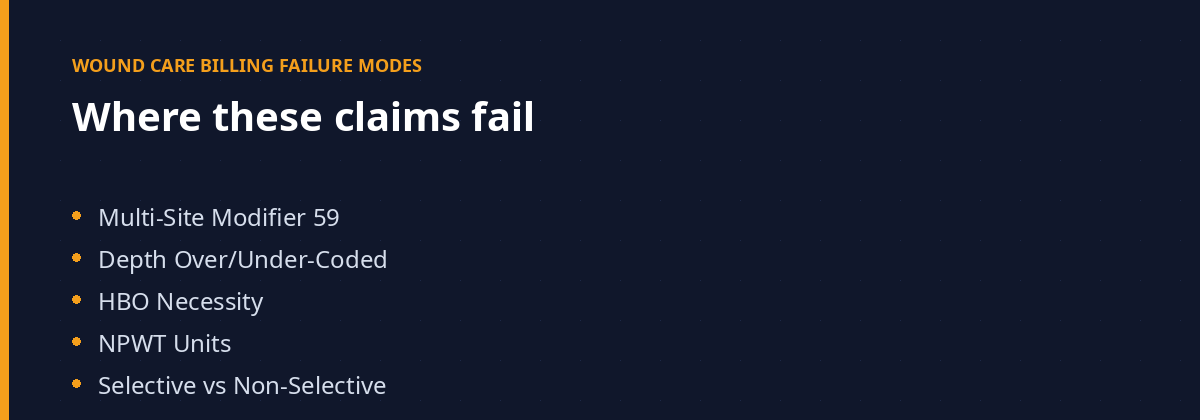
Wound care billing is governed by debridement depth ladders, multi-site modifier 59 rules, and HBO medical-necessity criteria that general billing companies cannot navigate effectively.
Multi-Site Modifier 59
Multiple distinct wound sites billed as one debridement line without modifier 59, losing per-site surgical revenue.
Depth Over/Under-Coded
Debridement depth (11042 vs 11043 vs 11044) billed to a depth the tissue documentation does not support, triggering medical-necessity denials or lost surgical revenue.
HBO Necessity
HBO 99183 denied when qualifying conditions (e.g. diabetic foot ulcer Wagner grade 3/4, refractory osteomyelitis, compromised flap) aren’t documented.
NPWT Units
NPWT 97605/97606 billed with incorrect surface-area selection or duration errors, losing per-session revenue.
Selective vs Non-Selective
Selective debridement (97597/97598, per 15 min) billed as non-selective mechanical (97602), losing the time-based units.
E/M With Debridement (mod 25)
Same-day E/M with debridement denied as bundled when modifier 25 isn’t appended to the E/M for a separately significant visit.
Common Wound Care Billing Codes
Quick reference for the most frequently used codes in wound care billing and coding.
| Code | Description | Common Use |
|---|---|---|
| 11042 | Debridement, subcutaneous tissue (incl. epidermis/dermis), first 20 sq cm | Surgical debridement — skin/subcutaneous |
| 11043 | Debridement, muscle and/or fascia, first 20 sq cm | Surgical debridement — muscle/fascia |
| 11044 | Debridement, bone, first 20 sq cm | Surgical debridement — bone |
| +11045 | Debridement add-on, subcutaneous, each additional 20 sq cm | Add-on to 11042 |
| +11046 | Debridement add-on, muscle/fascia, each additional 20 sq cm | Add-on to 11043 |
| +11047 | Debridement add-on, bone, each additional 20 sq cm | Add-on to 11044 |
| 97597 | Selective non-surgical debridement, first 15 min | Selective wound debridement |
| 97602 | Non-selective mechanical debridement | Wet-to-dry / non-selective |
| 97605 | NPWT, total wound surface ≤50 sq cm | Negative pressure wound therapy |
| 99183 | Hyperbaric oxygen therapy, per session | HBO therapy |
| Code | Description | Clinical Context |
|---|---|---|
| L97.x | Non-pressure chronic ulcer of lower limb | Chronic lower-limb wound debridement |
| L89.x | Pressure ulcer | Pressure-ulcer staging / debridement |
| E11.621 | Type 2 diabetes mellitus with foot ulcer | Diabetic foot ulcer |
| I83.x | Varicose veins of lower extremities with ulcer | Venous / varicose ulcer |
| I70.x | Atherosclerosis / arterial ulcer | Arterial insufficiency ulcer |
| M86.x | Osteomyelitis | Bone debridement / HBO qualifying condition |
| T81.3x | Disruption/dehiscence of surgical wound | Post-surgical wound dehiscence |
| L97.4 | Non-pressure chronic ulcer of heel and midfoot | Diabetic foot / heel ulcer |
| L08.x | Other local skin / subcutaneous infections | Infected wound / cellulitis context |
| T14.0 | Superficial injury / abrasion | Surface wound context |
| Modifier | Description | Wound Care Application |
|---|---|---|
| 59 | Distinct procedural service | Multiple distinct wound sites same session — critical |
| 25 | Separate E/M same day | E/M with same-day debridement |
| 52 | Reduced services | Partial debridement of documented area |
| 53 | Discontinued procedure | Debridement discontinued for patient safety |
| GA | ABN on file, medically unnecessary | ABN for non-covered debridement services |
| GX/GY/GZ | ABN variants | ABN for statutorily / non-statutorily non-covered services |
| LT/RT | Left / right side | Site-specific wound reporting where applicable |
| XS | Separate structure | Distinct anatomical wound sites |
End-to-End Wound Care RCM Solutions
Comprehensive revenue cycle management designed specifically for wound care practices.
Wound Care Billing & Coding
Specialty coders handle debridement depth coding (11042/11043/11044), selective vs non-selective debridement, and NPWT surface-area selection with accuracy.
Denial Management
Debridement depth defenses, multi-site modifier 59 corrections, and appeals with procedural documentation for wound care denials.
Multi-Site Modifier 59 Capture
Per-site debridement billing with modifier 59 on every distinct wound site, preventing multi-site bundling into a single line.
HBO Compliance
HBO 99183 qualifying-condition documentation, per-session tracking, and medical-necessity support before claim submission.
A/R Recovery
Prioritized follow-up on aged debridement, HBO, and NPWT claims with strategic payer escalation to maximize recovery.
Analytics & Reporting
Real-time dashboards tracking debridement depth mix, modifier 59 capture rate, HBO sessions, and NPWT surface-area billing.
Where Wound Care Revenue Leaks
Understanding the most common denial reasons is the first step to preventing them on debridement, HBO, and NPWT claims.
Multi-Site Billed As One
Multiple distinct wound sites billed as one debridement line without modifier 59, losing per-site surgical revenue.
Our Fix
Bill each distinct wound site with modifier 59 to preserve per-site debridement payment.
Debridement Depth Over/Under-Coded
Depth billed (11042 vs 11043/11044) not supported by documented tissue, triggering medical-necessity denials or lost revenue.
Our Fix
Match the debridement code to the deepest tissue documented in the operative note.
HBO 99183 Medical Necessity
HBO sessions denied when qualifying conditions (diabetic foot ulcer Wagner 3/4, refractory osteomyelitis, compromised flap) aren’t documented.
Our Fix
Document qualifying conditions and per-session necessity before each HBO claim.
NPWT Units / Duration Errors
NPWT 97605/97606 billed with incorrect surface-area selection (≤50 vs >50 sq cm) or duration errors.
Our Fix
Bill NPWT per applicable wound surface area and documented duration per session.
Where Wound Care Practices Lose Money
Identifying and plugging these common revenue leakage points can significantly improve your practice’s bottom line.
Multi-Site Dropped
Distinct wound sites bundled into one debridement line without modifier 59.
Depth Under-Coded
11043/11044 depth billed as 11042, losing muscle/fascia and bone debridement revenue.
HBO Sessions Denied
99183 denied for medical-necessity gaps when qualifying conditions aren’t documented.
Selective As Non-Selective
Selective debridement (97597/97598, per 15 min) billed as non-selective (97602), losing time-based units.
Without vs. With MedFactor
See how wound-care-specific revenue cycle management transforms your practice’s financial performance.
Without Specialty RCM
- ✕Multiple wound sites billed as one debridement line, losing per-site revenue
- ✕Debridement depth over- or under-coded against the documented tissue
- ✕HBO 99183 sessions denied for unsupported medical necessity
- ✕NPWT 97605/97606 billed with incorrect surface-area selection
- ✕Selective debridement billed as non-selective, losing time-based units
- ✕Same-day E/M with debridement denied as bundled without modifier 25
- ✕No visibility into debridement depth mix or modifier 59 capture rate
With MedFactor Wound Care RCM
- ✓Every distinct wound site billed with modifier 59 for per-site payment
- ✓Debridement depth matched to the deepest documented tissue
- ✓HBO 99183 documented with qualifying conditions before submission
- ✓NPWT billed by correct surface area (≤50 sq cm vs >50 sq cm)
- ✓Selective (97597/97598) separated from non-selective (97602) debridement
- ✓Modifier 25 applied to E/M with same-day debridement where appropriate
- ✓Real-time dashboards tracking debridement depth mix and modifier 59 capture
Your Path to Optimized Revenue
A structured onboarding process designed to deliver measurable improvements within the first 90 days.
Discovery & Audit
Review of wound care billing operations, debridement depth coding, modifier 59 capture, and revenue cycle baseline.
Setup & Integration
Wound-care EMR and HBO-system integration, dedicated billing team, and payer enrollment verification.
Go-Live Operations
Full billing with real-time claim submission, debridement depth verification, and denial prevention protocols.
Optimization
Performance review against baseline, workflow optimization, and documented revenue improvement.
MedFactor vs. Other Options
How our wound-care-specific approach compares to in-house billing and general medical billing companies.
| Capability | In-House Team | General Billing Co. | MedFactor Wound Care |
|---|---|---|---|
| Multi-site modifier 59 capture | Inconsistent | ✕ | ✓ |
| Debridement depth coding (11042/11043/11044) | ✕ | ✕ | ✓ |
| HBO 99183 medical-necessity documentation | Inconsistent | ✕ | ✓ |
| NPWT 97605/97606 surface-area selection | ✕ | ✕ | ✓ |
| Selective vs non-selective debridement | Manual | Partial | ✓ |
| E/M with debridement modifier 25 | Inconsistent | Partial | ✓ |
| HBO prior auth & qualifying-condition tracking | Manual | Partial | ✓ |
| Debridement depth mix reporting | ✕ | ✕ | ✓ |
| Dedicated wound care billing team | ✕ | ✕ | ✓ |
Why Wound Care Practices Trust MedFactor
Our team combines deep wound care billing expertise with the technology and processes to deliver consistent, measurable results for wound clinics, hyperbaric programs, and hospital outpatient centers.
- AAPC-certified coders with wound care and hyperbaric medicine coding experience
- Dedicated wound care billing teams — no generalists rotating through your account
- Real-time claim tracking with debridement depth mix and modifier 59 capture visibility
- Proven 42% average denial reduction within first 90 days
- Compliance program aligned with debridement depth and HBO medical-necessity rules
- smooth integration with wound care EMR and hyperbaric documentation systems
Get Your Free Wound Care Billing Audit
Discover exactly where your wound care practice is losing revenue. Our no-obligation audit analyzes your debridement depth coding, modifier 59 capture, and HBO compliance.
- Debridement depth coding (11042/11043/11044) assessment
- Multi-site modifier 59 capture review
- HBO 99183 medical-necessity documentation check
- NPWT 97605/97606 surface-area and selective debridement audit
Wound Care Practices We’ve Transformed
Real results from wound care practices that partnered with MedFactor for specialty revenue cycle management.
Wound Clinic Recovers Multi-Site Debridement Revenue
A wound care practice was billing multiple distinct wound sites as a single debridement line and dropping modifier 59. MedFactor implemented per-site debridement billing with modifier 59 on every distinct wound, recovering substantial surgical revenue in seven months.
HBO Program Fixes 99183 Medical-Necessity Documentation
A hyperbaric medicine program was losing HBO 99183 sessions to medical-necessity denials. MedFactor implemented qualifying-condition documentation before each session, recovering per-session HBO revenue across the year.
Hospital Outpatient Wound Center Optimizes Depth Coding
A hospital outpatient wound center was under-coding debridement depth and missing NPWT surface-area selection. MedFactor matched depth to documented tissue and corrected NPWT surface-area billing, lifting total wound-center revenue.
Wound Care RCM Across All 50 States
No matter where your wound care practice operates, our team understands the payer landscape and regulatory requirements in your region.
Medicare HBO Coverage
Medicare hyperbaric oxygen coverage criteria applied correctly across all qualifying-condition claims.
NPWT DME Rules
Negative-pressure wound therapy DME and surface-area rules applied per payer across all 50 states.
Multi-Site Modifier 59 Policy
Payer-specific modifier 59 policy for multiple wound sites applied correctly in every region.
Hospital Outpatient Wound Centers
Facility and professional billing coordination for hospital outpatient wound centers and clinic-based debridement.
Wound Care Billing Questions Answered
Common questions from wound care practices considering MedFactor’s specialty RCM services.
Surgical debridement codes are paid by the deepest tissue removed. 11042 covers debridement of skin and subcutaneous tissue (including epidermis and dermis) for the first 20 sq cm; 11043 covers debridement down to muscle and fascia; and 11044 covers debridement down to and including bone, each for the first 20 sq cm. Add-on codes 11045, 11046, and 11047 report each additional 20 sq cm for the corresponding depth. The code must match the deepest tissue documented in the operative note — over-coding triggers medical-necessity denials and under-coding loses surgical revenue. We match the debridement code to the documented tissue and bill each additional 20 sq cm with the correct add-on.
When debridement is performed on multiple distinct anatomical wound sites in the same session, each site is billed separately with modifier 59 (distinct procedural service) appended to the additional site(s). Without modifier 59, payers bundle the multiple sites into a single debridement line and the practice loses the per-site surgical revenue. Modifier 59 (or its X-series substitutes XS for separate structure, XP for separate practitioner, XU for unusual non-overlapping service) signals that the debridement sites are distinct and not duplicates. We bill each distinct wound site with modifier 59 to preserve per-site debridement payment.
Hyperbaric oxygen therapy (99183, per session) is covered by Medicare for a defined list of qualifying conditions, including diabetic foot ulcers (Wagner grade 3 or 4) that have failed a measured course of standard wound care, refractory osteomyelitis (M86), compromised skin grafts and flaps, crush injuries, necrotizing soft-tissue infections, and several others. Each session must be individually documented with the qualifying condition and medical necessity. HBO denials almost always trace to missing or unsupported qualifying-condition documentation. We document the qualifying condition and per-session necessity before each 99183 claim is submitted, which is the single biggest driver of HBO revenue recovery.
Negative pressure wound therapy (NPWT) is billed by total wound surface area per session. 97605 reports NPWT for a total wound surface area of 50 sq cm or less, and 97606 reports NPWT for a total wound surface area greater than 50 sq cm. The code is selected by the total surface area of all wounds treated with NPWT in the session, not per individual wound, and billed per session with documented duration. Errors include selecting the wrong surface-area tier and billing duration inconsistently. We select the correct NPWT code by total wound surface area and document the session duration so NPWT is paid at the correct tier.
Selective debridement (97597 for the first 15 minutes, plus 97598 for each additional 15 minutes) is the removal of specific devitalized tissue while sparing viable tissue, typically performed by a clinician with instruments. It is billed in time-based 15-minute units. Non-selective mechanical debridement (97602) is the removal of non-viable tissue without selective targeting, such as wet-to-dry dressings, and is not time-based. Billing selective debridement as non-selective (97602) loses the per-15-minute units; billing non-selective as selective without documented selective work triggers denials. We distinguish the two by the documented procedure and bill selective debridement in 15-minute units so neither revenue is lost.
We integrate with all major wound care and hospital outpatient platforms including Epic, Cerner, Athenahealth, Netsmart, and hyperbaric documentation systems, plus practice management systems. Our team works with your wound-measurement documentation, debridement operative notes, and HBO session logs so procedure detail flows cleanly to correct claim submission — including the debridement depth, multi-site modifier 59 detail, and HBO qualifying-condition documentation that drive accurate wound care coding.
Explore More RCM Specialties
MedFactor applies the same code-level precision across the full practice spectrum. See how we bill these related specialties.
CPT®, ICD-10, HCPCS, and modifier codes referenced on this page reflect the current code sets and are subject to annual updates — always verify against the current-year fee schedule before submission. CPT 11042–11047 debridement codes were confirmed active for 2024–2026 (no deletions in the May 2024 AMA Summary of Panel Actions; 11045/11046/11047 remain valid add-on codes per AAPC Codify and CMS LCD guidance). KPIs and case-study figures shown are representative benchmarks, not guarantees of individual practice results.
Sources and further reading
The rules these pages describe are published. Check them against the primary sources:
- CMS Physician Fee Schedule, which covers the published rates and payment rules behind most of the codes these pages discuss.
- CMS Physician Self-Referral (Stark Law), which covers the rules governing referrals between a practice and its own ancillary services.
- AAPC, which covers the coding and billing standards body whose credentialing most billers hold.
- HHS Office of Inspector General, which covers enforcement guidance on billing compliance and the areas it targets.


Stop Losing Revenue on Every Debridement
Your wound care practice deserves billing partners who know debridement depth coding, multi-site modifier 59, and HBO 99183 medical necessity — and code every claim correctly. Let MedFactor show you what specialty RCM can do.